

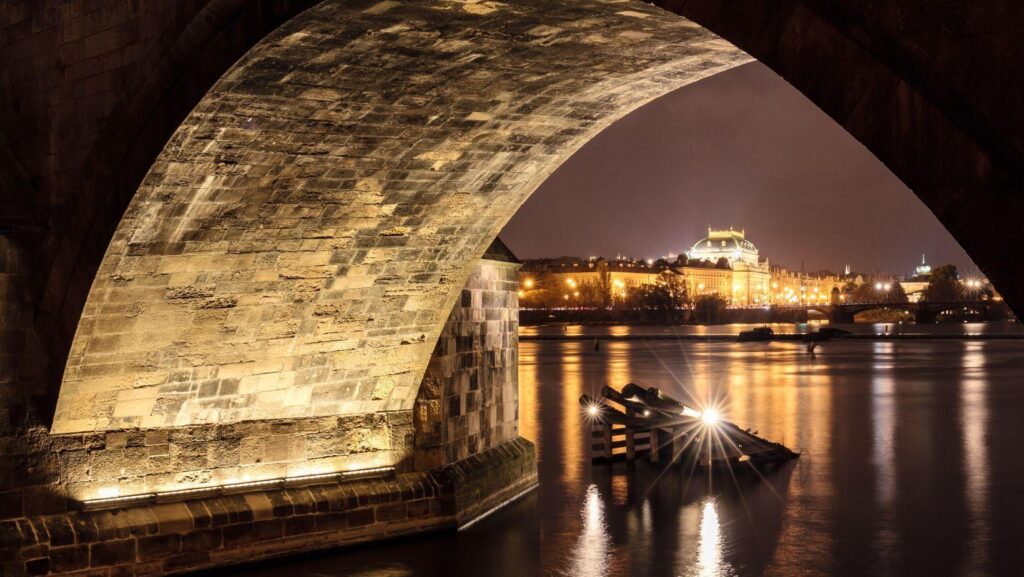
Every “best views of Charles Bridge” list sends you to the same four spots: Kampa Island, the Old Town Bridge Tower, Střelecký Island, the riverside terrace below the castle. All four put you level with the bridge or craning up at it from the bank, which is not where the bridge actually looks its best. The angle that shows off the sixteen stone arches, the piers worn smooth at the waterline, and the way the statues lean out over the river only exists from the river itself, at roughly deck-chair height. I went looking into evening cruises with dinner service mostly for the food, and the one company whose Prague listings actually spell out which route passes directly under the bridge instead of near it is Alle Travel, which is worth checking before you book a boat off its marketing photos alone.
What the Bank View Leaves Out
Stand on Charles Bridge and you get the statues at eye level, the crowds, the view toward the castle. Stand on the bank and you get a postcard of the facade from one fixed distance. What you don’t get, from either spot, is the underside: the arches, the sandstone piers, the way six centuries of river traffic have worn a different color into the stone below the waterline than above it. That view requires being under or beside the bridge, moving. On foot, that’s impossible. From the water, it takes about ninety seconds.
Most travel blogs covering “photo spots for Charles Bridge” don’t mention the water at all. They rank vantage points on land by how early you need to arrive to avoid crowds, which is useful information but answers a different question. The gap in that coverage is the boat angle itself. That’s not a footnote to a photography list. It’s the actual subject.
What Changes When You’re Level With the Water
The arches you never see on foot
The bridge has sixteen arches, the longest spanning about 13.4 metres, built between 1357 and 1402 under Charles IV to a design by the architect Peter Parler. None of that structure is visible from the bridge deck. You’re standing on top of it. From a boat passing underneath, the arches stack into a receding tunnel of sandstone, and for a few seconds the bridge stops being a flat backdrop and becomes an actual piece of engineering you’re moving through.
The statues from underneath
The thirty statues along the parapet were added long after the bridge itself was finished, most of them erected between 1683 and 1714. On foot you see them face-on, roughly at chest height, the angle they were carved for. From the water you see their undersides and the plinths they stand on, which is a different, less flattering view of the sculpture but a much better one of how the bridge is actually built up layer by layer. It’s less pretty and more informative, and I’d rather have the second thing in a photo. Most of what’s on the bridge now isn’t even the original stone, either: since 1965 the statues have been swapped out one by one for exact replicas, with the real ones kept indoors at the National Museum’s Lapidarium or in Vyšehrad’s Gorlice hall, safe from frost and acid rain. Look closely from the water and a few of the newer copies are still noticeably crisper-edged than their neighbors.
Picking a Cruise That Actually Gets You Under the Bridge, Not Just Past It
The operator listings mostly gloss over one detail: not every Vltava cruise routes close to Charles Bridge, and “sightseeing cruise past Prague’s landmarks” can mean anything from directly underneath to a few hundred metres downstream where the bridge is a shape on the horizon. The listing rarely says which. A ninety-minute dinner cruise that treats the bridge as one stop among six will slow down for it, maybe, but a shorter panoramic run built around the bridge specifically will loop back and pass it twice. If the water-level shot of the bridge is the actual goal and dinner is secondary, that distinction matters more than the menu does.
The stated route matters more than the marketing copy here, and I learned that comparing three listings side by side before picking one. “Passes Prague Castle, the National Theatre, and Charles Bridge” tells you the sights included, not the distance from any of them.
When to Go for the Light
Land-based photography of the bridge has one well-known problem. It’s busy by 8am and crowded by 10, and the only reliable empty-bridge window is before sunrise, somewhere around 5 to 6am in summer. Evening cruises sidestep that entirely, because the constraint on land, foot traffic, doesn’t apply on the water. What replaces it is a different constraint: light. Dusk cruises catch the bridge floodlit against a still-blue sky for maybe twenty minutes, and after that it’s just floodlit against black, which reads fine to the eye and flat in most photos taken from a moving boat without a tripod.
None of this is a reason to skip the sunrise option on foot if you’re up for it anyway. It’s a reason not to assume the two experiences are interchangeable substitutes for each other, because they solve different problems at different times of day.
The Trade-off Worth Knowing Before You Book
Worth knowing before you book, not after. A boat is not a tripod. It rocks slightly even in calm conditions, engine vibration included, and slower shutter speeds at dusk will pick that up as blur that a shot from a fixed spot on land never has to deal with. I lost several shots the first time out by staying on the wrong side of the boat and swinging the camera around only after we’d already passed underneath, instead of getting into position before the bridge came into view. Sitting on the side facing the bridge as you approach buys the steadiest few seconds. That’s a small, specific fix, not a reason to avoid the water angle altogether. Bad light and a good angle beat good light and the wrong angle, most of the time.
There’s also the quieter fact that Charles Bridge wasn’t the first crossing on this stretch of river. It replaced the Judith Bridge, a 12th-century structure destroyed by flooding, and the current bridge has itself been rebuilt more than once — a flood in 1890 tore down three of its arches, and it stayed closed for repairs until 1892. The river that gives you the good photo angle is the same one that has periodically taken the bridge apart. Worth remembering next time a cruise operator’s copy calls the Vltava purely scenic.
What sticks with me isn’t any single photo from that evening. It’s how different the same bridge looked twice in one night, once from a bench on Kampa Island and once from a boat passing underneath twenty minutes later, close enough that the sandstone blocked out the sky for a second. Most people only ever see one of those two bridges.