

Most people arrive in Albania with a list and no sense of scale. The country is small, roughly the size of Belgium, so the assumption is that you can see all of it in a week. You can see a lot of it. But the distances lie, because the roads climb, and a leg that looks like ninety minutes on a screen can eat half a day once you factor in the hairpins and the fact that you will keep stopping.
Here is a seven day route that respects that, built around the two things Albania does better than anywhere else in the region: mountains that almost nobody has photographed to death, and a coastline that still has gaps between the developments.
Days One And Two: Tirana, And Then Out Of It
Give the capital one full day, not more. It rewards a walk rather than a checklist. The Blloku district, sealed off to ordinary Albanians until 1991 and now wall to wall with cafés, tells you more about the last thirty five years than any museum. Then go and see a museum anyway: Bunk’Art 2 sits in the centre, in a bunker under the ministry of internal affairs, and covers the Sigurimi years with a restraint that makes it land harder.
For the view, take the Dajti Ekspres cable car up the mountain on the eastern edge of the city. Fifteen minutes, around 1,400 to 1,500 lek return, and closed on Tuesdays, which catches people out. Bunk’Art 1, the larger of the two bunkers, is at the lower station, so the two pair naturally in an afternoon.
On day two, leave. This is where the trip properly starts, and it is also where you need to decide how you are going to move around the country. Buses exist, and the minibuses called furgons cover routes no timetable admits to, but both are built for Albanians going home rather than visitors going sightseeing. Almost everything in this itinerary sits somewhere the bus does not stop.
Days Three And Four: The North
Shkodra is two hours north on a good road, and it is the gateway to the Albanian Alps. Rozafa castle above the town, at the confluence of two rivers, is worth the hour it takes, largely for the view over the wetlands.
From there the road to Theth climbs. It was gravel until 2021 and is now paved the whole way, which changed everything: an ordinary car can make it, and in summer you will see plenty of them. What has not changed is the shape of the thing, around 75 kilometres taking two and a half to three hours, ending with a descent of roughly 27 hairpins steep enough that you should be in second gear and off the brakes.
Theth is a scatter of stone houses under limestone walls, with a shingle roofed church that appears on half the postcards in Albania and a lock in tower where families sheltered men marked by blood feud. The Blue Eye spring above the village is a ninety minute walk each way. If you have an extra day, the pass over to Valbona is one of the finest day hikes in the Balkans.
Anyone who would rather not drive that road themselves can do the valley as an organised trip instead. Local operators run hiking and cultural experiences out of Shkodra, and guided hikes and local experiences in the Alps take the navigation off your plate while you concentrate on the scenery.
Day Five: Berat
Coming south, Berat is the stop worth sacrificing a beach day for. The Ottoman quarters stack white houses up both banks of the Osum, every window catching the light at a different angle, and the castle on the ridge is not a ruin but an inhabited neighbourhood with cats and laundry and a few hundred residents living inside thirteenth century walls.
The gate ticket runs around 300 lek, less if you buy online, and there is more than one way in, which explains why you will read contradictory prices everywhere. Park at the bottom and walk up. The lanes inside are cobbled at angles that punish a small car and there is almost nowhere to leave it.
Days Six And Seven: The South Coast
Gjirokastër, three hours on from Berat, is Berat’s grey stone twin, steeper and more austere, with a castle full of artillery and a captured American reconnaissance plane parked outside like a guest who overstayed. From there it is an hour to Saranda and the sea.
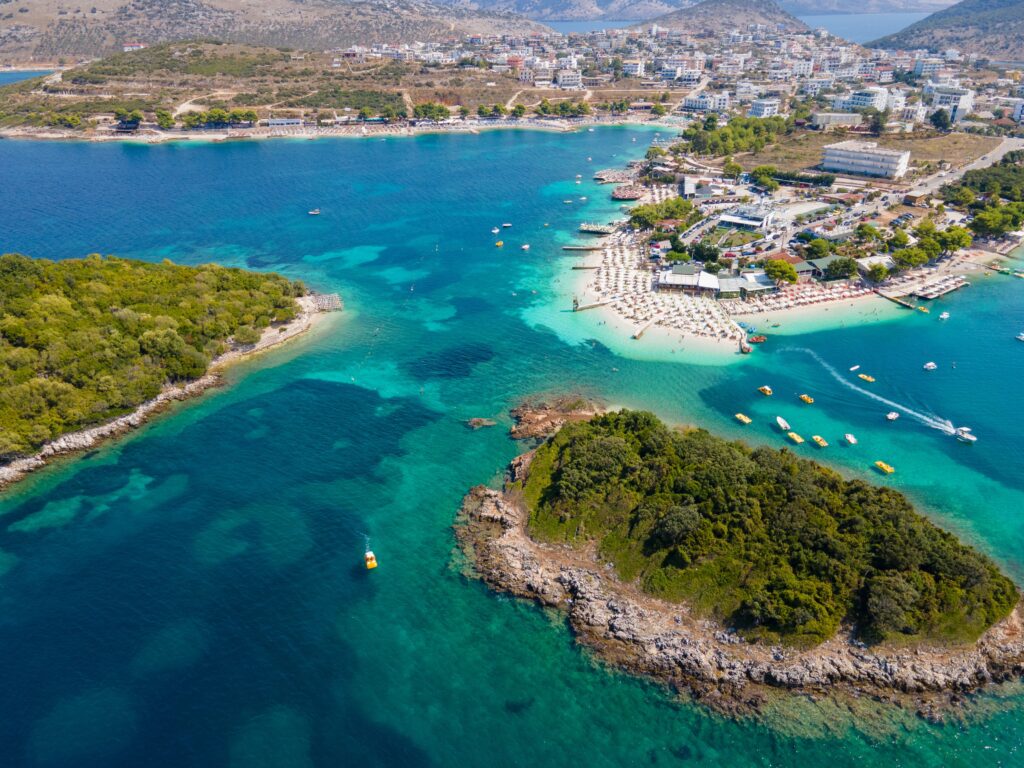
The far south holds Butrint, a Greek and Roman city quietly subsiding into its lagoon, and Ksamil, whose islets you can swim to and whose reputation in August is entirely deserved in both directions. Come at four in the afternoon when the coach parties leave.
Heading north from Saranda, the coast road is the drive of the trip. The Llogara Tunnel, nearly six kilometres long, now cuts under the pass and turns half an hour of switchbacks into about seven minutes. Use it in one direction and take the old pass road in the other, because the view from a thousand metres up, with the whole Riviera curving away below, is the single image most people bring home.
Getting Around: The Part To Sort First
For a route like this, a car is not a luxury, it is the itinerary. Rental from Albanian family operators costs roughly half what the international chains charge, and you can rent a car in Albania from around 7 to 12 euros a day outside the peak months, usually with delivery to the airport arrivals door and without the credit card deposit that leaves people stranded at counters every summer.
Two things nobody tells you. Fuel is expensive by regional standards, currently around 205 lek a litre, so budget above what you would spend in Greece. And do not drive at night outside the towns. There is no lighting, guardrails come and go, and you will meet unlit carts and livestock. This is the one rule worth keeping absolutely.
If the idea of driving here does not appeal at all, the compromise most visitors miss is to book a transfer from Tirana airport to your first base, then rent locally or take day trips from there. Fixed price, licensed drivers, and the Tirana to Shkodra run starts around 50 euros for the car rather than per person, which for two or three people beats the taxi rank by a distance.
Finally, on timing. May, June and September are the months. July and August bring the diaspora home and the coast fills, prices double and the good beaches lose their point. The mountains are still open into October, and the light in Theth in autumn is worth rearranging a calendar for.