

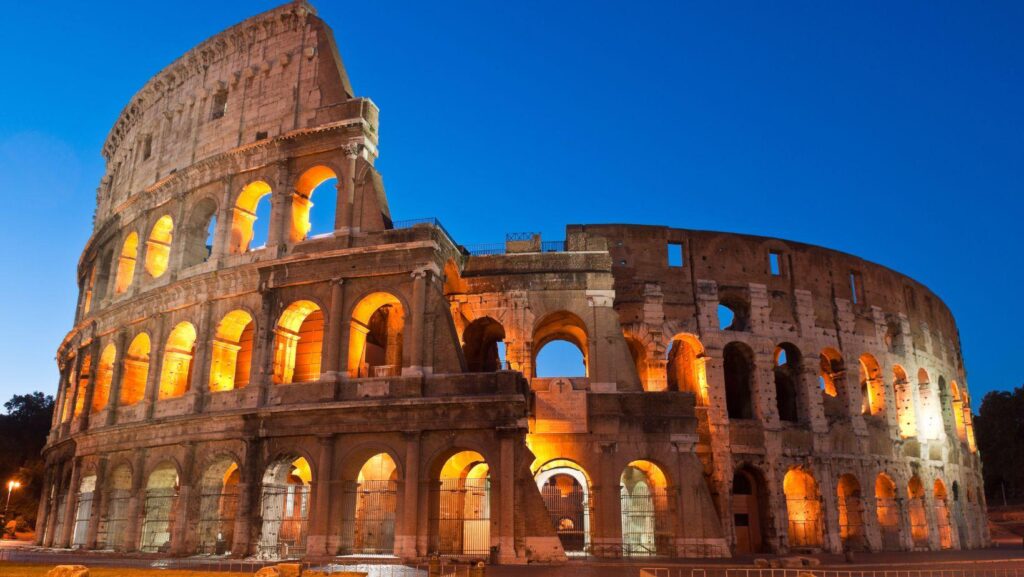
Rome has an unusual ability to make the distant past feel remarkably close. Ancient columns stand beside busy streets, fragments of temples appear between modern buildings, and the remains of an enormous imperial city occupy the centre of everyday life. For a first visit, the Colosseum and Roman Forum are the obvious places to begin understanding that history. They are visually spectacular, but they also make far more sense when you know how the two sites were connected and what you are actually looking at.
Arriving in Rome and Finding Your Bearings
Rome is easiest to explore when the historic centre is treated as a collection of walkable areas rather than a series of isolated attractions. The Colosseum sits southeast of the main centre, close to the Roman Forum, Palatine Hill and several other archaeological sites. From central neighbourhoods, walking can be just as useful as taking public transport, particularly because the streets themselves reveal layers of Roman history along the way.
Travellers arriving from northern Italy can also reach the capital comfortably by high-speed rail. The Venice to Rome train connects the two cities in a matter of hours, making Rome an easy addition to a wider Italian itinerary. Roma Termini is well connected to the rest of the city, although visitors heading directly towards the ancient ruins may prefer the metro or a taxi depending on luggage and arrival time.
The Colosseum: Start with the Icon
The Colosseum needs little introduction, but seeing it in person is different from encountering it in photographs. The scale becomes immediately apparent once you stand beside its exterior walls. Construction began under Emperor Vespasian in AD 72 and the amphitheatre was inaugurated by his son Titus in AD 80, creating a vast venue for spectacles attended by thousands of people.
Inside, the surviving structure reveals how carefully the building was designed. Tiered seating separated spectators according to social status, while entrances and corridors allowed huge crowds to enter and leave efficiently. Beneath the arena floor was the hypogeum, a network of passages and chambers used to prepare animals, scenery and performers before they appeared in the arena.
What Happened Inside the Amphitheatre?
The Colosseum hosted a wide range of public spectacles, including gladiatorial contests, animal hunts and elaborate performances. Modern descriptions sometimes reduce its history to gladiators alone, but the building was designed for much broader entertainment. The events were also closely connected with imperial power, allowing emperors to demonstrate generosity while reinforcing the hierarchy of Roman society.
It is worth remembering that the Colosseum changed considerably over its long history. After the decline of the Western Roman Empire, the structure was affected by earthquakes, stone removal and changing patterns of urban development. Parts of the building were reused for other purposes, contributing to the complicated appearance visitors see today.
Enter the Roman Forum
Just beyond the Colosseum lies the Roman Forum, an archaeological area filled with the remains of temples, government buildings, arches and public spaces. Unlike the Colosseum, the Forum can initially feel confusing because many structures survive only as fragments. That does not make it less impressive, but it does mean that some preparation can make the visit much more rewarding.
The Forum was the political, religious and commercial heart of ancient Rome. Senators gathered here, public speeches were delivered, religious ceremonies took place and important decisions affecting the empire were debated. Walking along the ancient streets gives a sense of how densely occupied the area once was, even though today’s ruins are separated by open archaeological spaces.
Look Up Towards Palatine Hill
Palatine Hill rises directly above the Forum and is included with many combined archaeological tickets. The climb is worthwhile for two reasons. First, the hill contains the remains of imperial palaces and other ancient structures. Second, it provides excellent views across the Forum and towards the Colosseum.
According to Roman tradition, Palatine Hill was associated with the legendary foundation of Rome by Romulus and Remus. Later, it became one of the most desirable areas of the ancient city, particularly for wealthy Romans and emperors. The remains of enormous palace complexes demonstrate just how important the hill became during the imperial period.
Understanding the Main Ruins
A little historical context can transform a walk through the Forum. The Arch of Titus commemorates the Roman victory over Jerusalem in AD 70, while the Temple of Saturn once stood beside an important ceremonial route. The Curia was associated with the Roman Senate, and the Via Sacra formed one of the Forum’s principal roads.
Not every column or wall can be confidently identified from ground level, which is why a good map, audio guide or guided tour can be useful. Avoid feeling pressured to understand every fragment. Instead, focus on a few major structures and imagine how the surrounding spaces would have looked when the Forum was functioning as the centre of Roman public life.
How Long Should You Spend There?
Allow at least half a day for the Colosseum, Forum and Palatine Hill. Visitors interested in archaeology or Roman history could comfortably spend considerably longer, particularly if they take time to read the information displays. Rushing through the three areas in an hour or two often means missing the connections between them.
A morning visit can be particularly pleasant because temperatures are usually more manageable and the light can be beautiful on the ancient stone. During the hotter months, bring water, wear comfortable shoes and use sun protection. Much of the archaeological area is exposed, with relatively little shade in certain sections.
Tickets and Visiting Practicalities
The Colosseum, Roman Forum and Palatine Hill are typically treated as one archaeological experience, but entry arrangements can vary. Check official ticket information before travelling, particularly if you want access to restricted areas or a particular time slot. Advance planning is sensible during busy periods, when popular entry times can sell out.
Security checks and queues can also affect the length of a visit. Arriving slightly before the assigned time gives you a better chance of entering without unnecessary stress. Comfortable footwear is more important than fashionable footwear, as the Forum includes uneven ancient surfaces and plenty of walking.
Pairing Ancient Rome with the Modern City
The archaeological sites make most sense when considered alongside the rest of Rome. After exploring the ruins, walk towards Monti for lunch or continue towards Piazza Venezia and the historic centre. The contrast between ancient remains and modern Roman life is one of the city’s defining pleasures.
Later, explore another part of the capital rather than filling the same day with more major monuments. Trastevere, the Pantheon area or Campo de’ Fiori can provide a change of atmosphere. Rome is best appreciated through contrasts, with archaeological sites, churches, cafés and ordinary neighbourhood streets constantly appearing alongside one another.
Conclusion
The Colosseum and Roman Forum provide an extraordinary introduction to Rome’s ancient history, particularly when the two are explored as parts of the same urban landscape. The amphitheatre demonstrates the scale and spectacle of imperial entertainment, while the Forum reveals where political, religious and commercial life unfolded. Add Palatine Hill for its archaeological remains and sweeping views, and the ancient heart of Rome begins to make sense as more than a collection of ruins. Give the area several hours, wear comfortable shoes and allow yourself time to look beyond the most famous structures. The details between the headline monuments are often where the city’s ancient character becomes most vivid.